New Book: Story Work for a Just Future

Delighted to announce the publication of our open access book Story Work for a Just Future: Exploring the Plurality of Knowledge and Method within the Digital Storytelling Community.

This collection from 47 authors in 15 countries represents the diverse voices of our international Digital Storytelling community, both in style and content. We hope it will inspire deeper connections, fruitful collaborations, and the creation and sharing of new stories that together will build a just future.
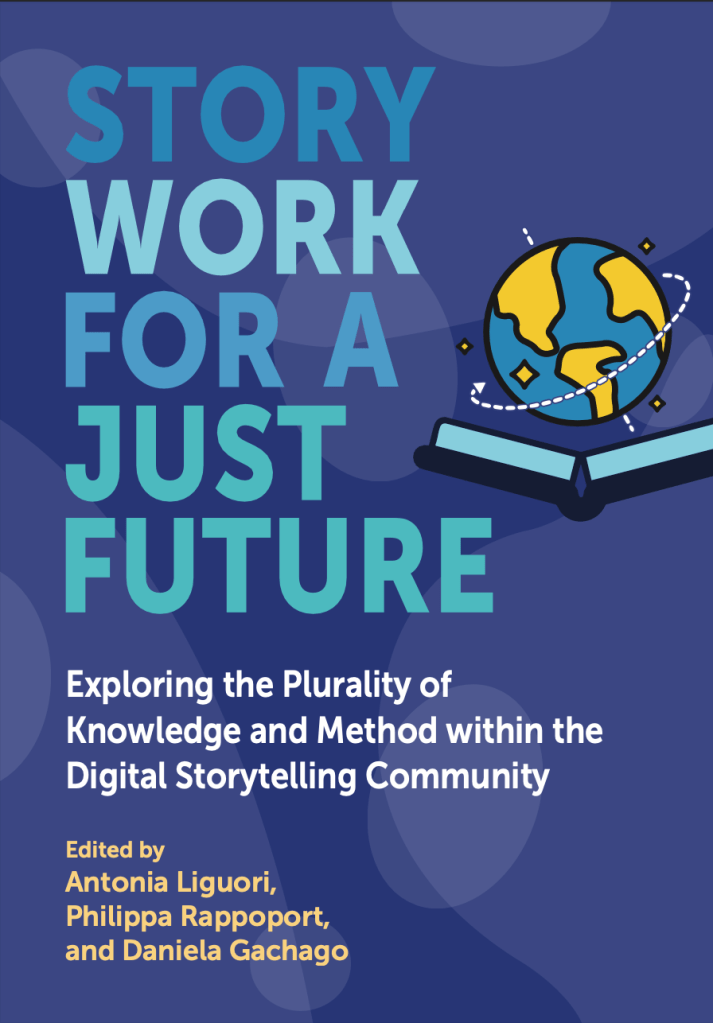
You can explore the book here: https://doi.org/10.5479/si.30758276

Very grateful to everyone who contributed to this important piece of work and to the Smithsonian Scholarly Press (SISP) for giving us the opportunity to publish with them.
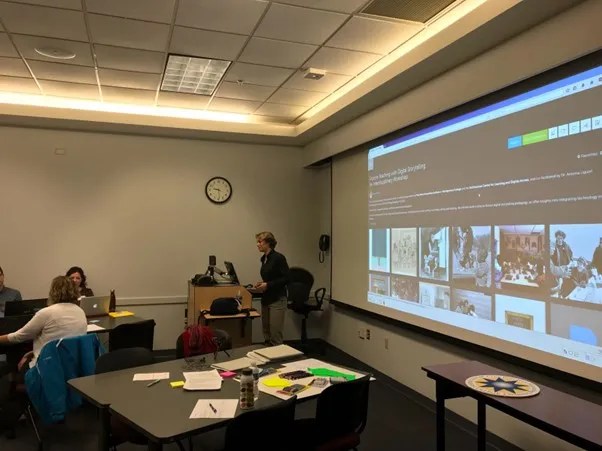
AI and Participatory Storytelling – A webinar for DicoLab Cultura al Digitale

MeltingPro just published on their YouTube channel the recording of my webinar on AI-Powered Storytelling in which I am sharing some emerging ideas from a collaboration with the Making of Black Britain and London Trasport Museum within the context of storytelling as anti-racist teaching pedagogy. The webinar is in Italian.

Storytelling partecipativo e IA – Webinar DICOLAB Cultura al digitale, May 2025

Digital Storytelling as a Tool for Active and Deep Learning

After almost a decade of hands-on workshops and ongoing research together, Philippa Rappoport (from the Smithsonian Office of Educational Technology) and I were invited to write an article for the Smithsonian Magazine to share the power of digital storytelling as an approach that makes learning more personal, emotional, and impactful.


Read more via Smithsonian Magazine about how we have leveraged digital museum resources and storytelling circles to invite learners to share their voice: https://www.smithsonianmag.com/blogs/smithsonian-education/2025/06/11/digital-storytelling-as-a-tool-for-active-and-deep-learning/

Plus, don’t miss our online session at the 2025 Smithsonian National Education Summit on Tuesday, July 15 at 12:00pm, Eastern. Check out the session line-up and register for free today: https://smithsonianeducation.swoogo.com/ses2025/home

Digital Storytelling workshop for museum professionals in Paris

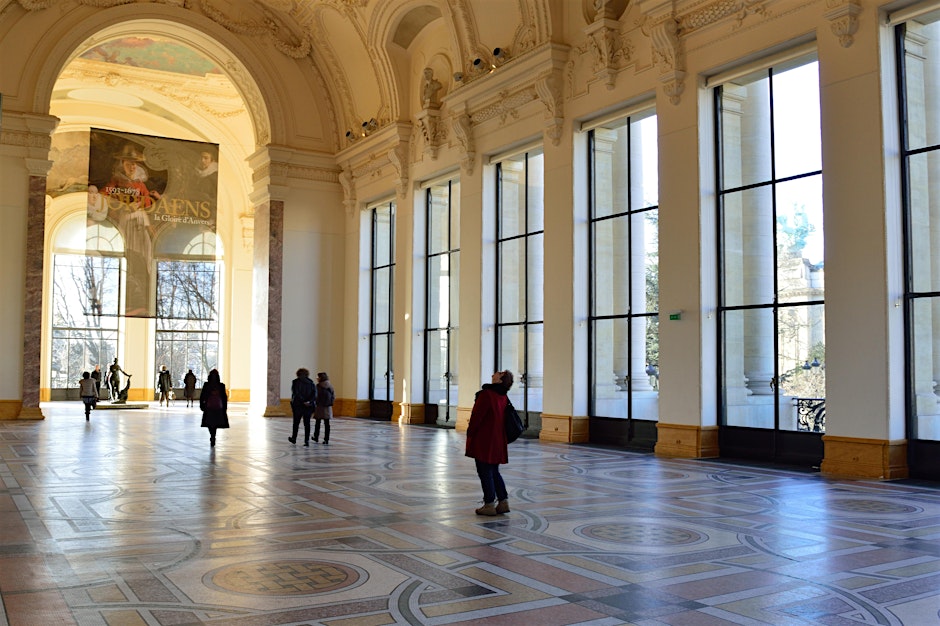
As a member of the Advisory Board, I will join the Digital-Spektrum project team for a workshop at the Petit Palais in Paris, on Friday 24 January from 14:00 to 17:00 CET, to explore Digital Storytelling as an inclusive approach for audience engagement.

The priority of the Digital-Spektrum project is to promote inclusion, diversity, and accessibility in all areas of education, particularly educational experiences that take place in museums. One of the main objectives of the Digital-Spektrum project is to provide museum staff with digital skills to design inclusive museum experiences with and for people with Autism Spectrum Disorder (ASD).

Continue reading “Digital Storytelling workshop for museum professionals in Paris”

New publication: Editorial: Towards 2030: Sustainable Development Goal 4: Quality Education

Delighted to have published our editorial and have worked with fantastic colleagues and dear friends (Philippa Rappoport, Smithsonian Institution, US; Antonella Poce, University of Roma Tor Vergata, Italy; Matthew Rabagliati, UK National Commission for UNESCO) on this very important Research Topic published by Frontiers, that addresses the fourth Sustainable Development Goal, which is to “ensure inclusive and equitable quality education and promote lifelong learning opportunities for all.”

This is the beginning of our editorial: Ambitious targets, as defined in the fourth United Nations Sustainable Development Goal (SDG 4) on “quality education” (WEF, 2016), are essential to stimulate innovative research around complex systems and also to extend and amplify the debate well beyond the academic community. Yet to achieve those targets inclusive language within policy and practice play a critical role (Kennett, 2021), in particular when considering communication as a tool to support democratic participation and knowledge exchange beyond institutionalized borders.

You can download and read the article via this link: https://www.frontiersin.org/articles/10.3389/fcomm.2023.1328002/full