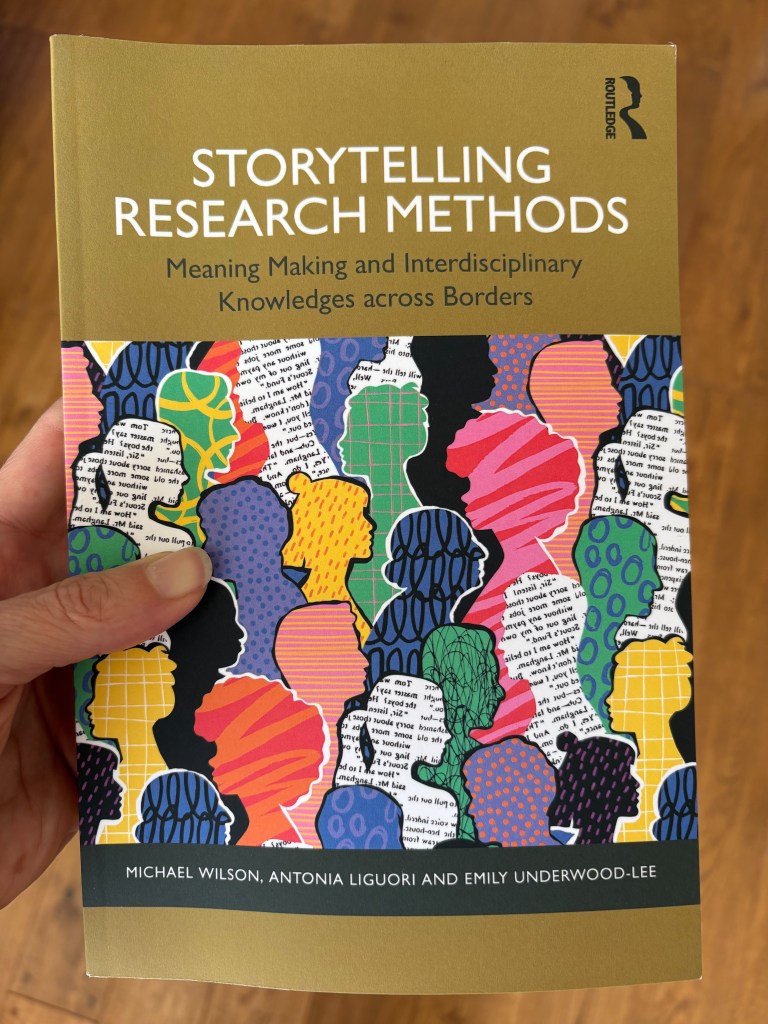
I am very happy to share the publication of our new book, co-authored with Michael Wilson and Emily Underwood-Lee. This work brings together years of collaboration, experimentation, and dialogue across disciplines, cultures, and research traditions.
Storytelling Research Methods establishes the methods, subject matter, tonal qualities, and philosophical underpinnings of Storytelling Research, while distinguishing it from its close relatives in Narrative Research, Narrative Inquiry, Performance Research, Autoethnography, and Qualitative Methods. The book includes philosophical discussion of Storytelling Research alongside practical advice on how to conduct storytelling research and international case studies from storytellers, scholars, and thinkers from Africa, Asia, Europe, and North America examining how storytelling methods have been used in practice.
For me personally, this book continues an ongoing commitment to participatory storytelling as a way of working across borders – disciplinary, cultural, institutional, and civic – to co-create understanding and imagine more just futures.
The video recording of our presentation at the Smithsonian National Education Summit 2025 is now online.
In this presentation, Philippa Rappoport and Antonia Liguori showcase ways to use digital storytelling with museum objects from the Smithsonian Learning Lab. You’ll leave with a toolkit of resources and activities to amplify student voices, build community, and increase classroom engagement and active learning across disciplines.
If you are interested in participatory storytelling and the role of AI within the cultural heritage sector – and you speak Italian – this webinar could be an interesting opportunity to share ideas, think together about co-creation and explore current case studies and future research.
You can read below the post just shared by the organisers in Italian.
After last week’s seminar at London School of Economics and Political Science, where I had the privilige to share my experience in applying digital storytelling as a praticipatory research approach with a group of brilliant researchers based at this world-leading social science specialist university, just awarded University of the Year 2025, this week I am delighted to join the Reflective practice in applied storytelling network as one of their speakers.
On Tuesday the 25th of February from 10:00 to 11:30 UK time, I’ll be talking about The benefits of co-facilitation within digital storytelling. In particular I will focus on a number of co-facilitation techniques that can enhance active listening and co-creation within the conventional digital storytelling process.
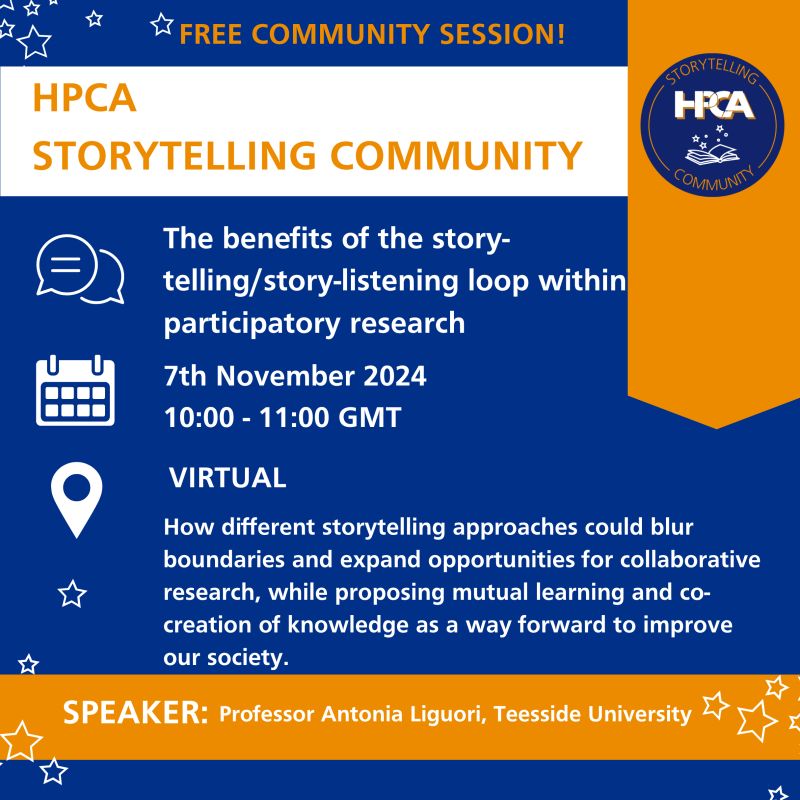
I am delighted to join the Healthcare Project and Change Association – HPCA for the november webinar with a talk on “The benefits of the story-telling/story-listening loop within participatory research: exploring diverse experiences and methods for the co-production of knowledge”.
Please read the abstract below and register to this event via this link.
Storytelling has been defined as ‘the artform of social interaction’ (Wilson, 2021), not only for its inner dynamics, but also for its power to unlock grass-roots knowledge, explore dilemmas, develop community resilience, and engender change. In a time when academia and cultural institutions are being challenged to encourage broader engagement with diverse knowledges, practices that support shared knowledge and co-creation become important. Stories can generate empathy and trust among diverse communities and audiences and at the same time demonstrate their usefulness due to their power to give meaning to human behaviours and to trigger emotions (Bourbonnais and Michaud, 2018).
In this talk we acknowledge the existence of multiple truths when we recognise, as the Nigerian novelist Chimamanda Ngozi Adichie observes, ‘the danger of a single story’ (2009). As she describes, ‘because our lives and our cultures are composed of a series of overlapping stories, if we hear only a single story about another person, culture, or country, we risk a critical misunderstanding’. In a time of worrying ‘critical misunderstandings’ worldwide, this talk – linked to the soon to be published by Smithsonian Scholarly Press open access book ‘Story Work for A Just Future’ edited by Antonia Liguori, Philippa Rappoport, Daniela Gachago – explores the value of co-created “Story work”.
In particular, we will focus on how different storytelling approaches could blur boundaries and expand opportunities for collaborative research, while proposing mutual learning and co-creation of knowledge as a way forward to improve our society.
Key questions prompted by this talk are:
How do we make the digital storytelling practice further expand globally in a way that is both locally-tailored-led-owned, but also coherent with the original ethos? Is co-creation an infallible antidote to exclusion and marginalization? Can we determine when digital storytelling ends and a new practice starts, if they are based on the same ethos?


 Antonia Liguori / Participatory Storytelling