Digital Storytelling with museum objects: exploring the benefits of co-creation within diverse learning communities

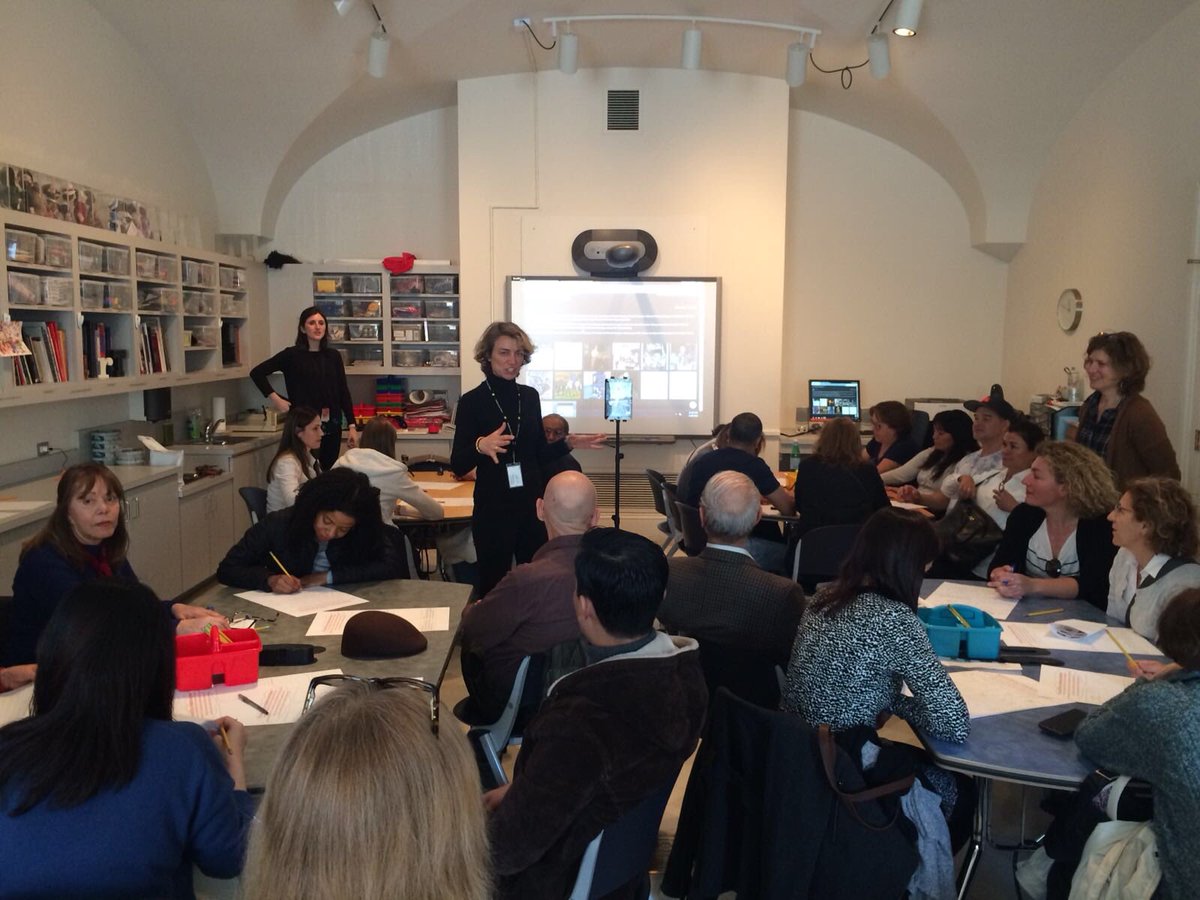
It is now accessible online the video-recording of my presentation at the European Open and Digital Learning Week 2023, as part of the panel on Well-being, Heritage and Higher Education Learning chaired by Prof. Antonella Poce, University of Roma Tor Vergata, Italy.

You can watch it here 50′ from the start of the panel.

EODLW 2023 – Well-being, Heritage and Higher Education Learning (my talk 50′ from the start)

You can read the abstract below.

Social interaction between peers is an essential factor in the development of an inclusive practice within formal and non-formal Education, aiming at increasing individual and collective wellbeing. Starting from this premise, Digital Storytelling is presented here as a transformative educational approach, considering the key values of its original model and the flexibility of the various tools applied within this participatory practice. In particular, the use of museum objects, both in the physical and in the virtual space, is suggested as a way of prompting the storytelling process during the story-circle, while exploring personal connections with the object itself. This activity has proved to enhance creativity and collaboration in a context in which mutual learning and peer support are prioritised. Our experience suggests that the role of emotion in the digital storytelling process is central to the promotion of ‘embodiment’, a specific form of knowledge that exists in ‘the telling of stories with emotional meaning’. This extraordinarily rich meaning-making process facilitated in the various steps of the Digital Storytelling approach, that constantly interweaves the personal and the collective, finds its engine in the hyper segmentation of the conventional DS model and its many disruptions driven by co-creation.
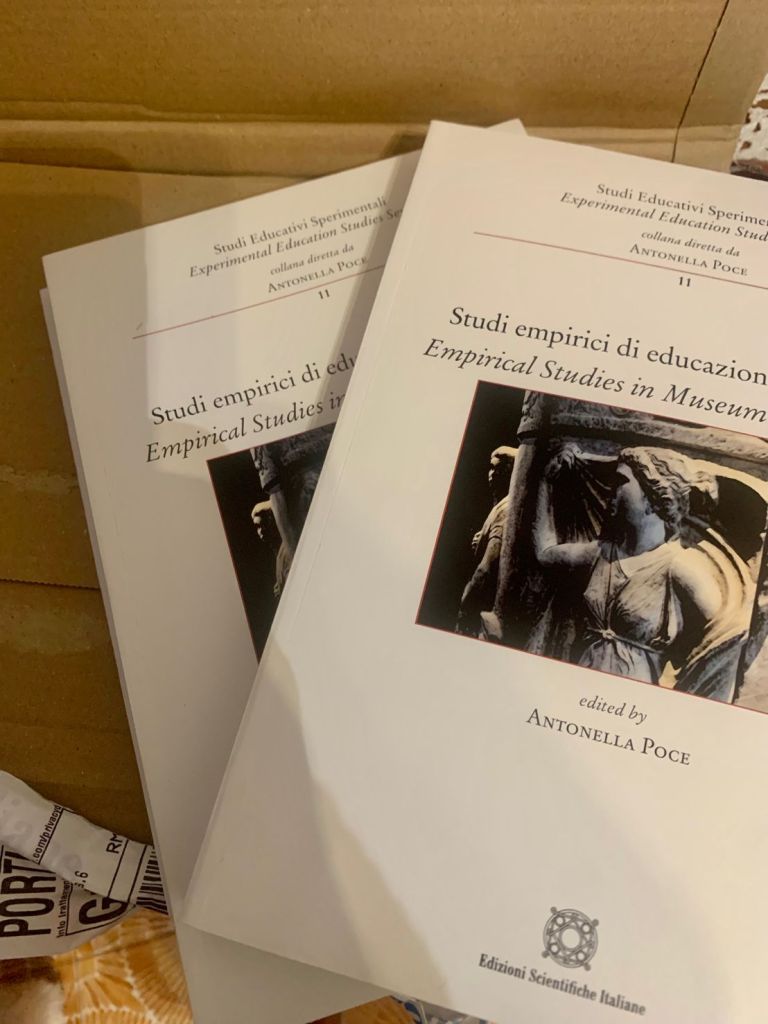
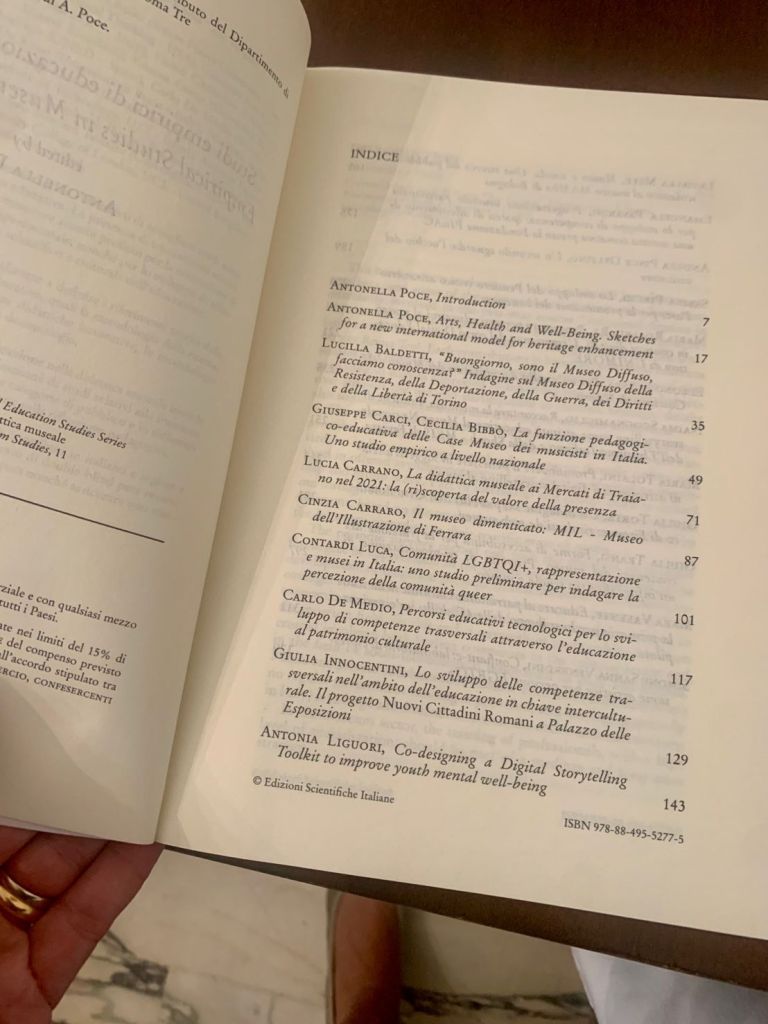
New publication: Co-designing a Digital Storytelling Toolkit to Improve Youth Mental Wellbeing

Grateful and delighted to have contributed a chapter on co-designing a digital storytelling toolkit for personal and collective wellbeing to this very interesting new volume on museum education edited by Prof Antonella Poce (Università di Roma Tor Vergata).

Please, read the abstract below.

Social interaction between peers is an essential factor in the development of an inclusive practice within formal and non-formal Education, aiming at increasing individual and collective well-being. Starting from this premise, Digital Storytelling was identified as the core methodology of this research, considering the key values of its original model and its flexibility as a participatory practice that enhances creativity and collaboration in a context in which mutual learning and peer support are prioritised. Considering the ongoing global challenge of funding mental health services, there is fertile ground for innovation, especially in the area of creative, online approaches to mental health literacy and healthy relationships among young people.
This paper explores the potential of applying participatory approaches, co-design techniques and digital storytelling as mixed methods to support youth mental well-being.

Please, cite as: Liguori, A., Co-designing a Digital Storytelling Toolkit to Improve Youth Mental Wellbeing, in Poce, A. (ed) Empirical Studies in Museum Education 3, E.S.I. – Edizioni Scientifiche Italiane, pp.143-160, ISBN: 978-88-495-5277-5.

Digital Storytelling and the concept of the “modern museum”

I was invited to write the afterward to the new book written by the Italian archeologist Elisa Bonacini Museums and Forms of Digital Storytelling, originally published in Italian by Aracne Editrice and now translated into English.

The research illustrates multiple experiences and strategies adopted in museums and in the world of cultural heritage in the field of digital storytelling to guide the future design of narrative digital solutions. Its aim is to provide as complete a picture as possible of the different solutions set in this specific sector of the field of cultural communication, their uses, and the accessibility of culture. It identifies and analyzes 14 types of digital storytelling: oral, written, video, visual, animated, interactive, Immersive, Social Media Storytelling, Participative, Generative, Geo–Storytelling, Multimedia Mobile Storytelling, Crossmedia and Transmedial storytelling. Finally, a new vision of the museum is proposed in which, beginning with the antiquarian and nineteenth–century vision of museum collections, develops into what should be defined as a connected museum or museum of connected narration.

Here the first lines of the postface:

The time has come for subversive storytelling (Zipes, 2016)

Storytelling is by its nature rooted in the past, influenced by the present and projected towards the future. It is so in its form and content, and digital technologies exponentially expand its channels of diffusion, broadening its horizon in the spatial dimension and accelerating its impact in the temporal dimension.As I write this afterword, with my mind still in full swing after reading the stimulating reflections and flawless reconstruction of this rich and profound book, my eye falls on a Twitter notification that pulls me into a “legitimate” distraction. That distraction, in reality, proves to be decisive in finding a thread to follow in these few lines that can give voice to my idea of using Digital Storytelling as a participatory tool to build “a justfuture” and to my expectation of finding in Museums that “social space” in which to preserve the stories of the past, listen to and represent the stories of the present, collaborate with local and global communities with ambition to imagine new stories and build a better future together. For everyone.

This postface is now accessible on Loughborough University’s repository and can be downloaded via this link: https://repository.lboro.ac.uk/articles/chapter/Digital_storytelling_and_the_concept_of_the_modern_museum_Postface_/21621351