Thursday 26th September Mike McGrother, Sally Blackburn-Daniels, Natasha Vall and I facilitated our first session to reflect on the emerging concept of ‘community engineering’ exploring musicking as an approach for community dialogue.
Our workshop was part of the very successful Everyday Creativity Conference, hosted by the AHRC Everyday Creativity Research Network and Creative Lives.
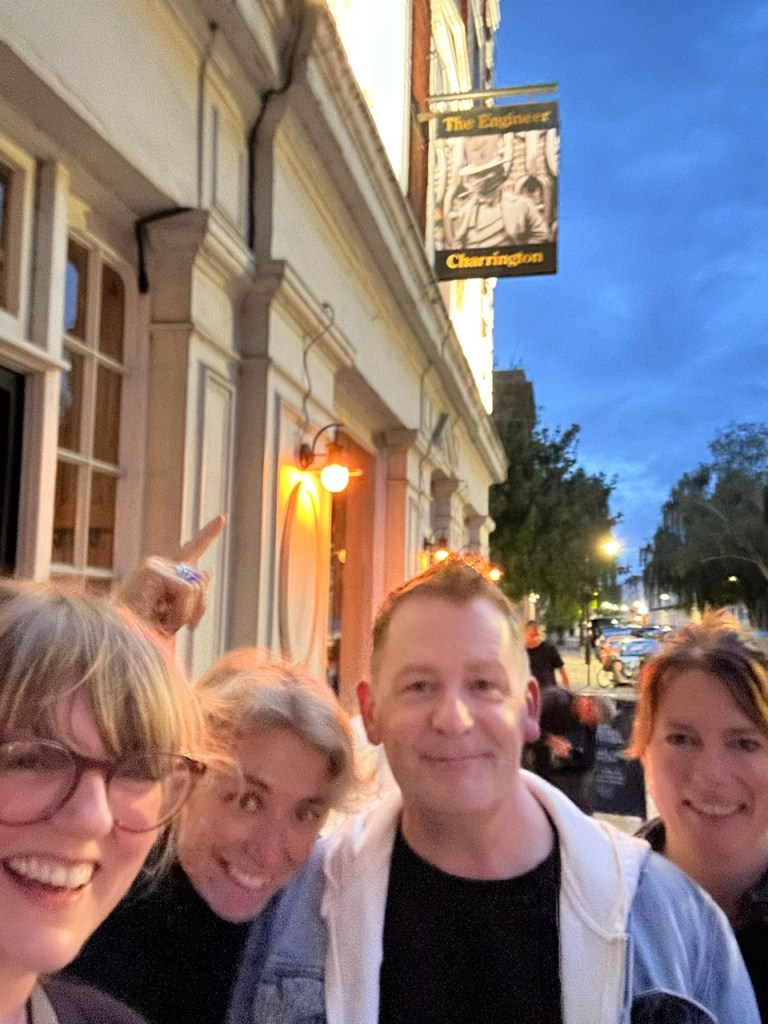
[In the photo of the Pre-conference dinner at the ‘Engineer’ from the left: Sally Blackburn-Daniels, Antonia Liguori, Mike McGrother, Natasha Vall]
This performative presentation has introduced Mike McGrother’s musicking practice as a co-created approach to enhance everyday creativity while exploring community’s sense of place in the Tees Valley. Starting with the premise that ‘the meaning of musicking lies in the relationships that are established between the participants by the performance’ (Small 1999), in this presentation we have explore ‘embodied listening’ (Giomi 2019) and the transition from personal to collective within the telling-listening loop (Liguori 2023) as a manifestation of everyday creativity and as a trigger for community-led placemaking.
We have also offered a platform for the audience to reflect on how to identify skills, approaches and tools that could support emergent ‘community engineers’ to replicate, adapt and expand existing practices.
Three songs were performed by McGrother – a song about, a song for and a song with – as stimuli to discuss the following three community projects, that offer new and nuanced understandings of community’s perspectives on placemaking and collective resilience:
• The Speakeasy – a (generally) pub based open gathering of older people who, through sociable and musical intervention, reminisce and share their stories – reconnecting with their community and enjoying company.
• Trailblazers, narrative focused walks with a musical edge that are co-created by people and enable stories to be shared.
• Infant Hercules and The Haverton Hillbillies. Musical, sociable, and empowering ensembles that underpin and provide a collective voice for a community.
Across the three initiatives, over 1,500 community members were involved in the three Boroughs of Middlesbrough, Stockton-on-Tees, and Redcar & Cleveland.
This performative presentation has ended with a collaborative mapping exercise (see padlet below) to explore the potential impact of these musicking initiatives beyond their current regional reach and to challenge existing barriers for their replicability and longevity.


