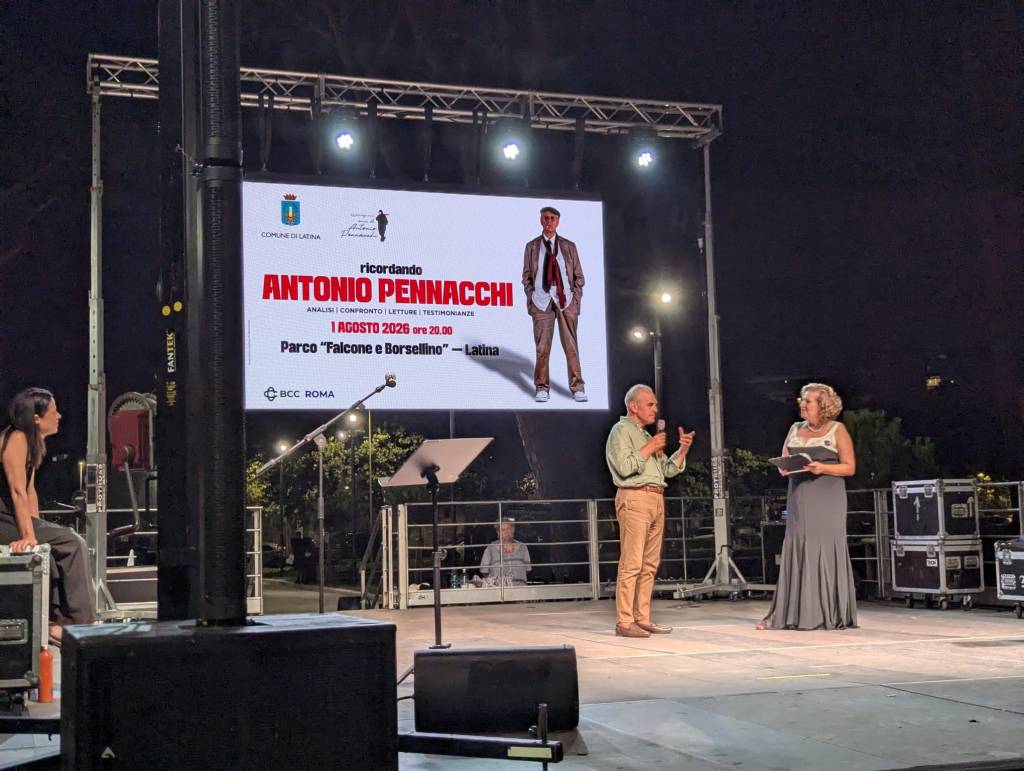
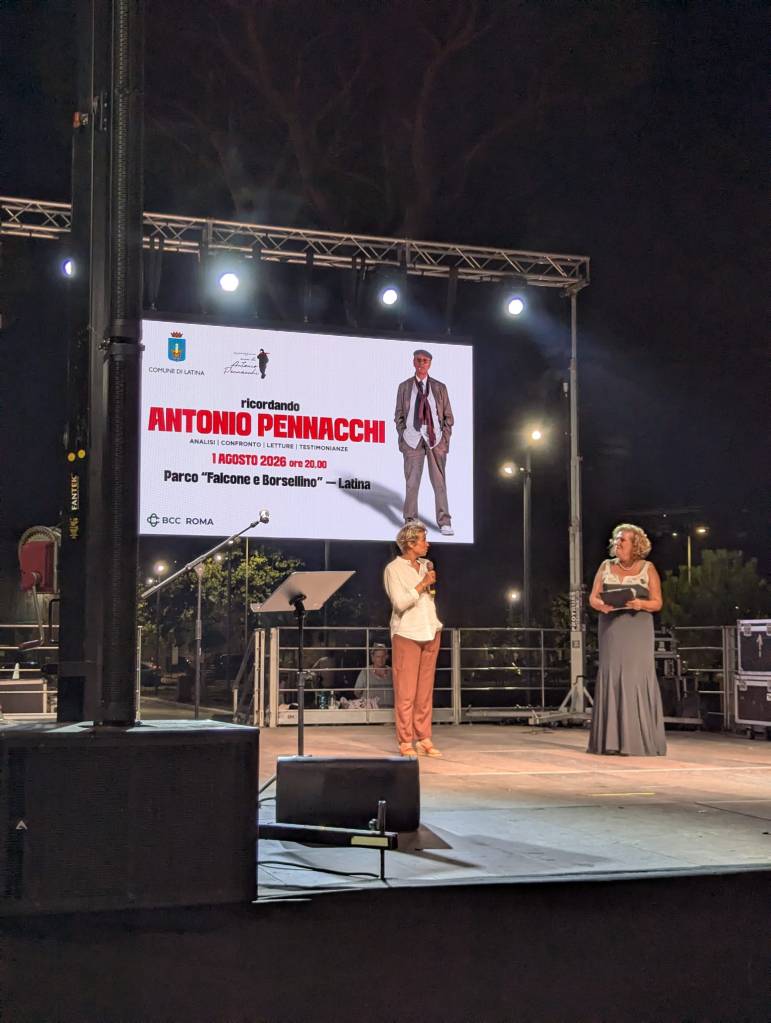
Yesterday, Pietro Antonelli and I returned to our hometown of Latina to take part in an event celebrating the life and legacy of Antonio Pennacchi, organised by Marco Ragonese, Graziano Lanzidei and “L’Associazione Amici di Antonio Pennacchi” and presented by Daniela Novelli. It was much more than a commemorative occasion. It was an opportunity to revisit a chapter of our lives and to remember a remarkable writer before he became one of Italy’s most celebrated literary voices.
Today, Antonio is rightly remembered as the winner of the prestigious Premio Strega for Canale Mussolini and as one of the writers who most profoundly explored the complexities of Italy’s twentieth-century history. Yet our memories go back to a different time, when his extraordinary talent was already unmistakable but had not yet reached the wider public.
Those years were formative for many of us.
Pietro, then Founder and Editor-in-Chief of La Piazza and later Il Settimanale di Latina, recognised Antonio’s distinctive voice and invited him to collaborate with the newspaper. Between 1999 and 2001, Antonio worked with us as part of his journalistic practice, eventually obtaining his membership of the Ordine Nazionale dei Giornalisti. Long before literary prizes and national recognition, he was already writing with the uncompromising honesty and intellectual courage that would later define his novels.
Looking back, however, I realise that Antonio’s story cannot be separated from another story: that of La Piazza itself.
Under Pietro’s editorial leadership, La Piazza became far more than a local weekly newspaper. It evolved into a genuine civic space, a kind of intellectual gymnasium where journalists, writers, academics, artists, students and citizens could exchange ideas, challenge one another and engage with the issues shaping our territory.
Many people who would later contribute significantly to journalism, public administration, politics, education and cultural life found in those pages an opportunity to develop their voice. Some were experienced professionals, many were taking their very first steps. What united them was the possibility of experimenting, questioning assumptions and discovering that journalism is not simply about reporting events, it is about creating the conditions for public conversation.
Antonio fitted naturally into that environment.
His writing was never designed to reassure readers or reinforce established narratives. Instead, he constantly challenged inherited assumptions, inviting people to confront the contradictions embedded within Italian history and, in particular, within the identity of our own region. His articles often generated passionate debate and occasionally uncomfortable disagreement. Yet those discussions represented something invaluable: a community willing to engage with complexity instead of retreating into silence.
My own memories of Antonio are connected to another, rather unexpected story, one that reminds me how culture travels through seemingly random encounters.
In 2003, I was at the beginning of my academic journey, undertaking my PhD in History and Computer Science at the University of Bologna while also collaborating with Professor Clara Castelli at the University of Rome La Sapienza. Together, we organised a weekly Saturday seminar (as part of a module of History of Historiography) exploring the novel as a historical source, examining how literature can reveal dimensions of history that official archives and historical documents often cannot.
One week I suggested that one of the students read Antonio’s then relatively recent novel Il Fasciocomunista. At the time, Antonio was still largely known within literary circles rather than by the wider public. The student was deeply impressed by the novel and recommended it to her aunt and her aunt’s husband, who happened to be a film producer.
That simple suggestion created an extraordinary chain of events.
The novel became the inspiration behind Daniele Luchetti’s acclaimed film Mio fratello è figlio unico, a film that would go on to receive numerous awards and introduce many more people to the themes Antonio had been exploring years before he became a household name.
I have always loved this story because it reminds us that cultural impact rarely follows predictable routes. Sometimes it begins with a newspaper article. Sometimes with a university seminar. Sometimes with one reader recommending a book to another. Stories move through relationships before they become part of history.
Yesterday’s event also made me reflect on why Antonio’s work remains so relevant today and for the future generations.
Antonio was, above all, a disruptor.
Not because he sought provocation just for its own sake, but because he believed that difficult conversations mattered. He refused simplistic narratives and instead explored the uncomfortable intersections of political, social and cultural identities. In a region whose history has often been marked by ideological divisions, he contrasted the temptation to reduce complexity to slogans. He understood that communities grow when opposing perspectives are brought into dialogue rather than pushed further apart.
As someone whose own research has focused for many years on participatory storytelling, I increasingly see Antonio’s work through this lens.
Storytelling is not about producing consensus.
It is not about persuading everyone to think alike.
Nor is it about identifying a single, authoritative version of the truth.
Instead, storytelling creates spaces where multiple voices can coexist. It enables disagreement to become curiosity rather than conflict, uncertainty to become a source of learning rather than fear, and imagination to become a resource for building shared futures.
These are perhaps the reflections that both Antonio and Pietro taught me, each in different ways.
Antonio challenged us through literature. Pietro created spaces where those challenges could be discussed publicly. One unsettled accepted truths through his novels and journalism; the other built platforms where writers, journalists and citizens could engage with those ideas openly. Both understood that democracy depends not on unanimity but on conversation, and that genuine conversation requires courage, generosity and a willingness to listen as much as to speak.
As I reflected yesterday, I realised how fortunate we were to witness – and, in our own ways, contribute to – that remarkable period in Latina’s cultural life. It was a time when local journalism, literature and civic engagement intersected in ways that shaped not only individual careers but also the identity of a community.
Antonio Pennacchi’s legacy extends far beyond the books he wrote. It lives wherever stories are allowed to remain complex, wherever different perspectives are welcomed rather than feared, and wherever people continue to believe that dialogue – even when difficult – is the foundation of a vibrant democracy.
For me, this is the added value of storytelling.
Not to eliminate differences, but to hold them together creatively.
Not to silence opposing voices, but to give them space.
Not to offer certainty, but to cultivate the imagination, curiosity and courage that allow communities to build more just and inclusive futures.

