
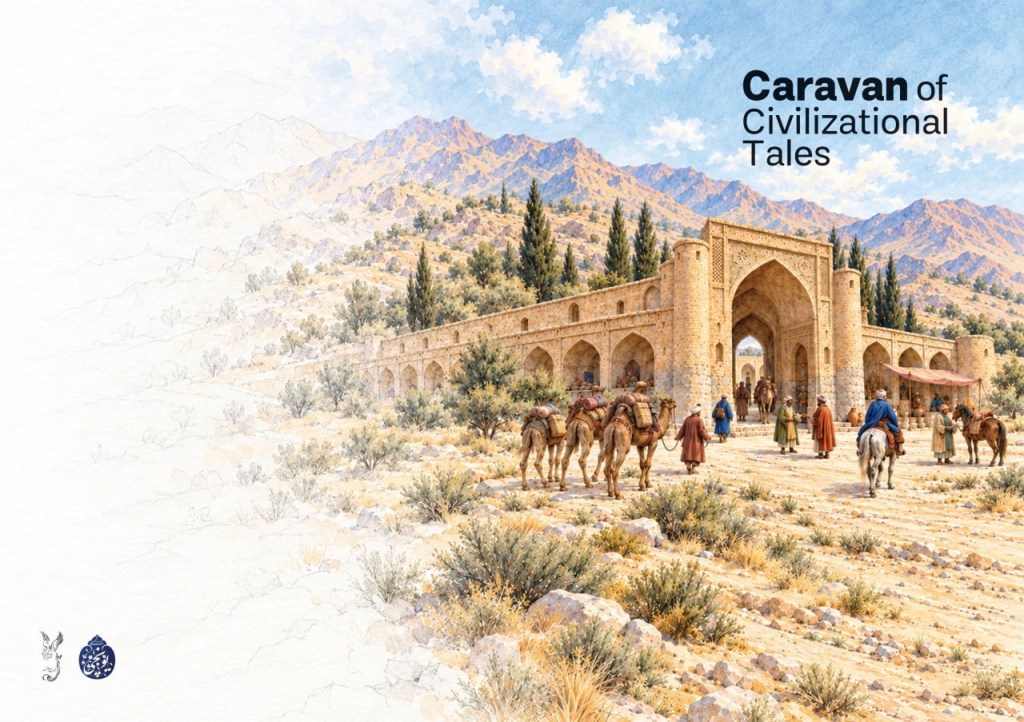
I had the privilege of contributing the Foreword to “Caravan of Civilizational Tales”, a peace-centred anthology conceived and curated by Melika Tabrizi, founder of the Silky Land Storytelling Institute. A writer, storyteller, playwright and tireless champion of peace-making, Tabrizi has brought together voices from multiple countries in a project inspired by Iran’s historic caravanserais, transforming these ancient spaces of encounter into a contemporary dialogue about culture, connection and peace. The book was officially launched in Tehran on the International Day of Peace.
While writing the Foreword, I found myself reflecting on what storytelling can offer in a world increasingly shaped by division, conflict and uncertainty. This led me to explore the definition of the process of storytelling as social act of “connective imagination“. Not just “collective” through the telling-listening loop, but “connective” as a driver for social justice.
By connective imagination, I mean our ability to engage with lives, experiences and perspectives beyond our own. The ability not only to understand, but also to feel and see thorugh someone else’s heart and eyes, even where we perceive ‘distance’. Stories allow us to travel across cultural, linguistic and geographical boundaries, not by erasing difference but by creating opportunities to encounter it. Through storytelling, we are invited to listen, reflect and imagine relationships that extend beyond the limits of our immediate experience.
In my mind, connective imagination is not simply about empathy. It is also about social justice and peace-making. Stories help make visible voices and experiences that are often overlooked. They create spaces where different perspectives can coexist and where communities can explore shared concerns while recognising distinct histories and identities. More than this, storytelling can nurture a collective capacity to imagine futures that are more just, inclusive and peaceful than the present. And to do so, we need to embrace diverse perspectives.
This is what I find particularly compelling about “Caravan of Civilizational Tales”. Like the caravanserais that inspired it, the book creates a meeting place. It gathers stories from different cultures and traditions while reminding us that dialogue, curiosity and mutual recognition remain essential foundations for peaceful coexistence.
At a time when public discourse is often fragmented and polarised, projects like this remind us that peace is not only built through diplomacy and policy. It is also cultivated through cultural exchange, shared narratives and the imaginative capacity to see the world through the eyes of others. That, perhaps, is the enduring power of connective imagination.
More info on the book launch and on the ethos behind this project on Silky Land website: https://silkyland.com/official-launch-of-the-book-caravan-of-civilizational-tales/

