On Tuesday the 8th of December at 12:00pm UK time, we will be launching our recently published book Storytelling Research Methods: Meaning Making and Interdisciplinary Knowledges across Borders, co-authored and edited by Michael Wilson, Antonia Liguori and Emily Underwood-Lee.
The event will be both in person – in Cardiff, at the University of South Wales, the Zen Room at the Atrium – and online. You can register via this event page: https://southwales.libcal.com/calendar/futureready/Storytelling_research
About the book
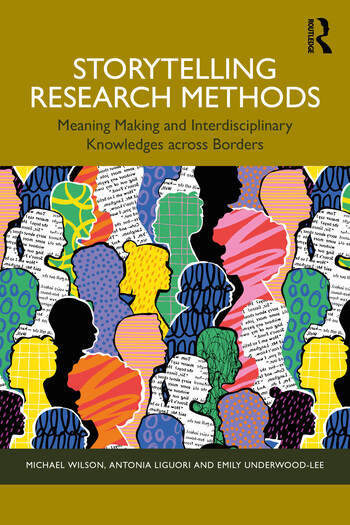
This title establishes the methods, subject matter, tonal qualities, and philosophical underpinnings of Storytelling Research, while distinguishing it from its close relatives in Narrative Research, Narrative Inquiry, Performance Research, Autoethnography, and Qualitative Methods. The book includes philosophical discussion of Storytelling Research alongside practical advice on how to conduct storytelling research and international case studies from storytellers, scholars and thinkers from Africa, Asia, Europe, North America, and Oceania (New Zealand) examining how storytelling methods have been used in practice.
The distinctive emphasis in Storytelling Research is on the telling of stories – that is, on the vibrant moments in which stories are summoned into the psycho-cultural space between individuals and groups. The creation, documentation and analysis of such moments are tasks of activism as well as pure research – their intention is to bring the world to a renewed condition, while advancing our understanding of such artful interactions. The book traces the interdisciplinary genealogies of storytelling research in Folklore, Performance Studies, Theatre, Communication Studies, Literature, Socio-linguistics, Sociology, History, and other contemporary lenses, while making the case for storytelling as its own uniquely rooted formation. It establishes holistic connections between storytelling as performing art and storytelling as a tool for generating data and social change.
About the authors
- Professor Michael Wilson (Loughborough University) is Professor of Drama, UNESCO Chair in Storytelling Education for Sustainability and Director of the Storytelling Academy.
Professor Wilson’s main research interests lie in the field of popular and vernacular performance. He has published extensively on Storytelling (and its social and policy applications), Grand-Guignol and Brecht and his collaborators. In particular, Professor Wilson’s work on storytelling has led him to research into the interface between storytelling and digital technology and the way in which the internet has enabled the telling and sharing of ‘extraordinary’ stories of the everyday experiences of people. - Professor Antonia Liguori (Teesside University) is Professor of Participatory Storytelling and Public Policy and and co-director of the Institute for Collective Place Leadership.
Professor Liguori is a world leading expert in Digital Storytelling and has applied it across all the continents as a participatory and inclusive method to amplify diverse voices, particularly in relation to environmental and social challenges, advocating for structural changes through collective and engaged storytelling practices.
Over her career, she has had the privilege to experience a very diverse and exciting pathway, both in the heritage sector in Italy and in academia in the UK (Loughborough University 2014-2023; Teesside University 2024-present), - Professor Emily Underwood-Lee (University of South Wales)
is Professor in in Research and Development and Co-Director of the George Ewart Evans Centre for Storytelling and Co-Chair of the Violence Against Women, Domestic Abuse and Sexual Violence (VAWDASV) Research Network Wales.
Professor Underwood-Lee’s work focuses on how the arts can help to understand and amplify little-heard personal stories from people whose voices may have been marginalised or overlooked, and on the difference that hearing these experiences can make to policy, practice, and everyday life for both teller and listener. She has a particular interest in stories of the maternal, gender-based violence, disability, gender, health and illness, and heritage.

